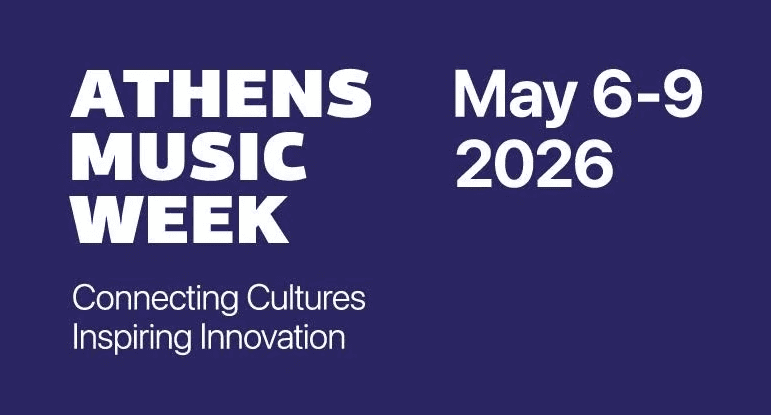
Athens Music Week runs 6-9 May 2026. Goethe-Institut Athens for the conference, PLEX, ΚΛΑΚΑΖ and the French Institute for showcases. The 8th edition is held under the auspices of the Hellenic Copyright Organization (HCO).
Over 100 activities on the programme. Most aren't for you. The 14 below are. If you run an indie label or work on the team, this is your AMW. Sessions marked Closed require an invitation or are members-only. Sessions marked Registration required are open but capped, so book now.
Wednesday 6 May
15:45 - Bridging Balkan Borders listening session: New music from Southeast Europe | Goethe Auditorium
A first listen to material from a 4-day SE European songwriting residency. In the room: Konstantinos Adam (A&R Indie Pop & Alternative, Stay Independent), Vanias Apergis (Founder & Director, Yellowgroove), Marko Anastasov (CEO, MUZE Corp / Bulgaria), Dimitris Beltsos (Songwriter/CEO, Arcade Music) and Jay Stolar (Executive Producer, FATE RECORDS & HUME / US).
If your A&R radar covers the SE European corridor, the first concrete read of the week.
18:00 - AMW Reception by EKKOMEΔ | Goethe Terrace
The Hellenic Film and Audiovisual Center (EKKOMEΔ) hosts the opening reception. Music and audiovisual professionals in one room with the broader creative industries. Registration required.
If you've got sync ambitions or any catalogue exposure to film and audiovisual, the most efficient first-night networking moment of the week.
Thursday 7 May
11:30 - Beyond the hubs: The rise of Europe's next touring markets | Goethe Seminar Room
Christian Cléret (CEO, Dionysiac Tour) and Leonardo Lupelli (Federation of Music Conferences) on Southeast Europe, the Balkans and the Mediterranean as live markets. Niko Michault (P.U.S.H Music Management), Mark Dieler (Sicily Music Conference) and artist Melina Vlachos round out the room. The corridor AMW is built around. Question after the panel: who in your team owns the territory plan?
12:00 - AI & music: Moving past the fear, towards real practice | Goethe 2004
Matt Cartmell (Chief Executive, Music Technology UK) moderates, with Pantelis Vikatos (Sr Director Research & Innovation, Orfium), Thais Ruiz de Alda (Digitalfems) and Stelios Karozis (Pharos AI Factory). What label operators are doing now with AI tools, what's integrated, what isn't. If you haven't formed a position on AI tooling yet, treat this as a briefing.
12:00 - Ο ρόλος του Εκδότη / The Role of the Music Publisher | Goethe Auditorium
Greek-language panel running parallel to the AI session. Vanias Apergis (Yellowgroove) moderates, with George Myzalis (COO, EDEM Rights), Ilianna Antoniou (AUTODIA), Stefanos Dasopoulos (Stay Independent), Andreas Papadopoulos (D-Version Music Publishing) and Irina Loukatou (Musou Music Group). Stay Independent + AUTODIA + EDEM Rights together is the most concentrated Greek publishing-and-CMO conversation of the week. You'll need to pick: AI room or this one.
13:45 - Built for music: Tools, ideas and real-world solutions | Goethe 2004
A live show-and-tell of music business tools. Hosted by Becky Brook and Sakis Triantafyllakis (Director of Operational Excellence, Orfium). Founders demoing include Pierre-Alban Mulliez (CEO, Claimy), Frédéric Herout (CEO, Music Magnet), Benoit Menet (CEO, Music Tomorrow), Gérôme Vanherf (CEO, ikii), Dimitris Komninos (CEO, Mood) and Lazaros Penteridis (CEO, ComeTogether).
For label ops leads still on disconnected spreadsheets and platform dashboards, the most efficient hour of the week to scan what's available.
15:00 - From local traction to international markets: How Greek artists grow | Goethe Seminar Room
The flagship Thursday panel for indies. Powered by The Orchard. Mandy Salem-Aubry (International Conference Director, AMW) moderates, with Mihalis Kaloudis (Director, The Orchard Greece), Andreas Periklis Metaxas (Stay Independent), Andreas Kefalas (CDO / Head of Copyright, Broma 16) and Panagiotis Loulourgas (Head of International / A&R Manager, Panik Records). The senior people running the strongest international arms in the Greek market on one stage.
Friday 8 May
11:30 - Spotify Masterclass: Growing your audience and reaching beyond borders | Goethe 2004
Spotify's Southern & Eastern Europe team (Emilia Mihailescu, Katarzyna Czechowska, Ekaterina Pirogova) on Spotify for Artists tools, pitch flow and audience growth. Regional team, regional context. Registration required.
Come with one specific catalogue question. The Q&A is worth more than the slides.
13:15 - Greece & Bulgaria in the new Southeast European music landscape | Goethe 2004
Powered by BAMP. Our CEO Luciano Winter is a speaker on this panel.
Moderated by Boral Shen (Executive Director, Bulgarian Association of Music Producers), with Manos Dedevesis (COO & Head of Publishing, Stay Independent), Stanislava Armoutlieva (CEO/Owner, Virginia Records), Magdalena Sotirova-Ivanova (Managing Partner, Monte Productions) and Oleg Rozov (Director Eastern Europe & Central Asia, The Orchard).
The two gateway markets into a region of over 70 million people (Serbia, North Macedonia, Turkey). Schengen developments matter operationally for live touring and crew mobility. If you're active or planning activity in SE Europe, this is where the operating reality gets discussed by the people running the labels.
14:30 - Innovation and the law: Where to move fast and when to stop | Goethe 2004
Mandy Salem-Aubry moderates, with Eric Reithler-Barros (CEO, Fold Artists), Becky Brook, Chris Hocking (Founder, The Factory Music Group), Eva Moustaka (HCO) and Alexandros Nousias (Pharos AI Factory). Suno, Udio and training-data attribution under existing copyright frameworks. Are independent rights holders in the rooms where licensing terms get set?
16:15 - How to build a direct fanbase that lasts | Goethe 2005
Marion Sosnowicz (Head of Business Development, Music Glue) on direct-to-fan operations at scale. Iron Maiden, James Blunt, Enter Shikari in the back catalogue of campaigns. 60-minute interactive workshop. Registration required.
If you're reducing platform dependency on streaming, where the operating model gets concrete.
Saturday 9 May
11:00 - HERMES Association inaugural event | Conference Goethe Auditorium [Invite only]
The official launch of HERMES, the new Association of Greek Independent Music Companies. Hosted by Manos Dedevesis (COO & Head of Publishing, Stay Independent).
The single most significant moment of AMW 2026 for European indies. A new national indie association in a market where Stay Independent currently runs up to 58% of the local digital chart share has direct implications for how Greek catalogue value gets collectively represented at European policy level. If you do business in or with Greece, be in the room.
13:45 - AI, copyright and Greece: The rights question no one can avoid | Goethe 4004
Yannis Iliopoulos (Senior Programmes Manager, ICMP London / Founder, The Sound of Everything) moderates, with Maria-Daphne Papadopoulou (Acting Director, Hellenic Copyright Organization) and Maria G. Sinanidou (Counselor at Law / Certified Mediator, HCO).
The Acting Director of the HCO sitting on a public AI panel is the signal. EU AI Act, training data, transparency requirements as they're being interpreted in Greece right now. For label heads with active songwriter relationships and catalogue exposure, this connects the morning's HERMES launch and Friday's Innovation and the Law panel into one operational picture.
15:00 - Beyond the Algorithm: Curators, Collectors & Community | Goethe 3002
Powered by Crates. Stathis Kalatzis moderates, with Matthias Strobel Hohmann (President, Music Tech Germany), George Ilias (Founder, Crates), Katerina Mortzou (DJ, K.atou) and Vassilis Sevdalis.
Where the value of taste gets captured commercially when the algorithms keep flattening it. If you invest in catalogue depth and curation, this one.
Saturday closes with the strongest showcase curation of the week: Lefty (GR), Foehn (FR), Rhumba Club (UK), 505 (IT/DE), Hana Fatur (SI), Obadu (HU), Iota (GR).
Closed-door sessions worth knowing about
Two sessions on the programme are invitation-only and won't open to general delegates. Worth tracking because the conversation shapes what surfaces in the public panels:
Thu 16:00 - Music Tech Europe General Assembly | Goethe 3002. Members and partners only, classified as a Private Meeting on the AMW programme. Hosted by Jose Zagazeta (Barcelona Music Tech Hub) and Turo Pekari (Copyright Delta), with Anna Zò (President, Music Tech Europe), Georges Perot (Artistic Director, AMW), Matthias Strobel Hohmann (Music Tech Germany) and Matt Cartmell (Music Technology UK).
Fri 10:30 - Music & AI Forum "Knowledge as Infrastructure" | Goethe-Institut Athens. Closed expert roundtable hosted by Music Tech Europe. Moderated by Yvan Boudillet (Secretary General, Music Tech Europe) and Turo Pekari, with Konstantinos Karavezis (CMO & CFO, Stay Independent), Eric Reithler-Barros (Fold Artists), Henry Umunnakwe (Metavallon VC) and Michael Petychakis (CTO, Dialectica). Output from this room will surface in Friday afternoon's Innovation and the Law panel.
The pattern across four days
HERMES launches Greece's first dedicated indie association. The southeast European corridor gets mapped as a live and catalogue-value region of Europe. AI licensing frameworks are being written, mostly without independent rights holders in the room.
Every session above maps back to one question: who's building the infrastructure that the next decade of European independent music will run on, and who's paying rent to use it.
What happens after the summit is decided by the operators paying attention.